
Why Nepal is Becoming a Dream Honeymoon Destination
Planning Your Italy Honeymoon: Destinations, Timing & Insider Tips
A practical guide covering the best regions, when to visit, and what most couples overlook

The short version: go in September, combine two regions (not three), book a private boat day on the Amalfi Coast, and stop Googling “best hotel Positano” because Praiano is where you actually want to stay. Italy rewards couples who plan a little and then leave room for the rest to just happen.
Now the longer version.

I’ve spent the better part of twelve years helping couples plan honeymoons across Italy, and the conversations always start the same way. “We want to do Rome, Florence, Venice, the Amalfi Coast, maybe Tuscany, maybe Sicily, and we have eight days.” And I always say the same thing: pick two places and actually live in them. Three at the very most. Italy isn’t a checklist. The best moments happen when you’ve got nowhere to be, and you wander into a trattoria because the terrace looked nice and the waiter talked you into the house wine.
Check out this Italy Honeymoon vlog to get a glimpse of how it can look like:
Where Should You Actually Go?
The Amalfi Coast if you want drama. Vertical villages, water so blue it looks edited, lemons the size of your fist growing from every wall. But skip Positano as your base. Go for the afternoon, take photos, and have lunch. Then go back to Praiano, which faces due west, where the sun drops into the sea between Capri and the Li Galli islands every single evening. The whole town stops and watches. Fewer hotels, no nightlife, no crowds. For a honeymoon? Perfect.
Lake Como if you want quiet elegance. Long mornings on a terrace overlooking still water, with the Alps in the background. Bellagio gets called the “Pearl of the Lake,” and it earns it. But Varenna on the east shore is smaller, less polished, more real. You can walk the entire town in twenty minutes, and the Lovers’ Walk along the waterfront at sunset is almost unfairly romantic. For more about this iconic lake, read this National Geographic article.
Watch this video to get a glimpse:
Tuscany if you want to slow right down. No ferry timetables, no coastal roads. Just hills, vineyards, villages built from golden stone, and dinners that run three hours because nobody’s counting. The Val d’Orcia area around Montalcino and Montepulciano is the landscape you’ve seen in every Italian film. It looks exactly like that. Better, actually.
Rome + Amalfi Coast if it’s your first time in Italy and you want both culture and coast. Three nights in Rome, then head south. The Colosseum, Trastevere’s backstreets, a long dinner in a piazza. Then decompress on the coast with sea air and limoncello.
Sicily if you want the Italy that nobody else at your wedding went to. Taormina has a Greek theatre with Etna smoking in the background. Cefalù has some of the best beaches on the Mediterranean. And the street food in Palermo is a religion.
Quick guide:
| You want… | Head to | How long |
| Coastline + drama | Amalfi Coast | 5-7 nights |
| Quiet + refined | Lake Como | 3-4 nights |
| Wine + countryside | Tuscany | 4-5 nights |
| Culture then coast | Rome → Amalfi | 7-10 nights |
| Something different | Sicily | 7-10 nights |
Two regions in ten days is the sweet spot. Three starts feeling like a relay race.
When Should You Go?
September. That’s my answer, and it has been for years.
The summer crowds vanish almost overnight. The weather stays warm, around 22-26°C on the coasts. Hotel prices drop 20-30% from July’s peak. And across Tuscany and Piedmont, the grape harvest brings vineyard dinners, wine festivals, and that specific golden light that makes everything look like a painting.
Watch this honeymoon in Italy vlog for more inspiration:
May and early June are the other window I recommend. Spring flowers across the countryside, comfortable temperatures for walking in Rome, and the season hasn’t hit full throttle yet.
July and August? It’s still Italy. It’s still going to be special. But Positano’s streets feel like the Tube at rush hour, restaurant prices spike, and you’ll queue for everything. If summer’s your only option, look at Puglia or Sardinia instead. Fewer people, same coastline.
| When | Temperature | Crowds | Prices |
| April-May | 15-23°C | Moderate | Mid-range |
| June-August | 25-32°C | Heavy | Peak |
| September-October | 18-26°C | Manageable | Mid-range |
| November-March | 5-14°C | Quiet | Low |
What Do Most Couples Get Wrong?
I’ve watched hundreds of honeymoon itineraries go out the door. The same mistakes keep coming back.
They skip the boat day. On the Amalfi Coast, a private boat for the day costs €500-800 with a local skipper. He’ll take you to coves where you swim alone, anchor near Capri, and slice fresh mozzarella on the deck while you float in water so clear you can see the bottom at ten metres. Every single couple says it was the highlight. Everyone.
They try to see everything. Italy punishes rushing. The best meal of your trip will be the one you didn’t plan, the one where you sat down because the terrace smelled like garlic and basil, and the owner waved you in. Build in at least one day with absolutely nothing scheduled. You’ll thank me.
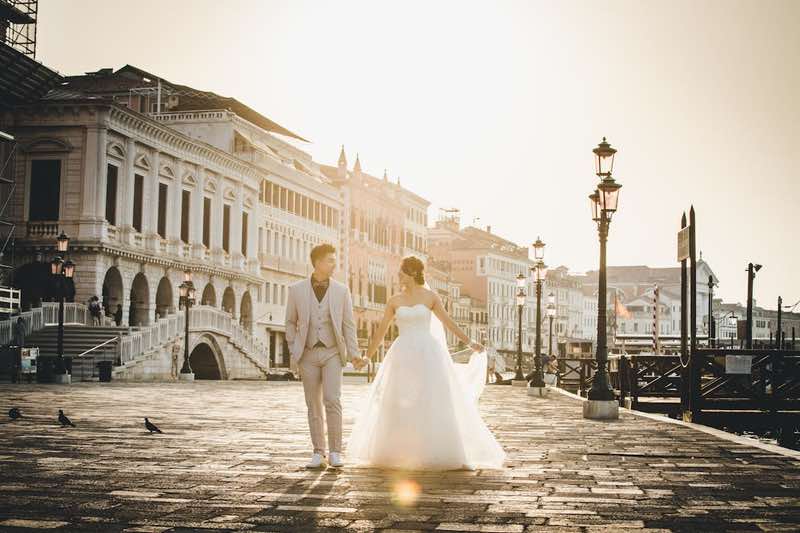
In Venice…Photo by carlo bettuolo on Pexels.com
They ignore the maths on timing. A September honeymoon costs €2,000-3,000 less than the same itinerary in July. Same hotels. Same restaurants. Better weather, actually. And that money? Put it toward the boat day. Or an extra two nights.
They book a return flight. Fly into one city, out of another. Rome in, Milan out. Or Naples in, Venice out. It costs roughly the same as a return and saves you an entire day of backtracking. This single tip changes every itinerary I plan.
They forget the countryside. A cooking class at a Tuscan farmhouse where you roll pasta on a board worn smooth by fifty years of use. A truffle hunt in the October woods with a guy and his dog who’ve been doing this since before you were born. Dinner at an agriturismo where the tomatoes grew ten metres from your table. These aren’t tourist activities. They’re the reason you came.
What Does It Actually Cost?
Straight numbers, because vague ranges help nobody.
For a comfortable 10-day honeymoon with four-star hotels, proper restaurants, and a few meaningful experiences, plan on roughly €8,000-15,000 per couple. That includes flights from the US or UK.
At the luxury end with five-star properties, private guides, and no compromises? €18,000-25,000 or more.
Accommodation eats 40-50% of the budget. A solid four-star in a good location runs €150-250 per night. Step up to proper luxury, and you’re at €500-1,000. The palace hotels and iconic names go beyond that.
One thing worth knowing: some of the best meals in Italy cost €30-40 per person. Handwritten menu, no English, plastic chairs, wine from a jug. Don’t assume expensive means better here. That’s not how Italian food works.
Finding the Right Help
The honeymoons that go smoothest tend to be the ones where someone who actually knows the ground handled the logistics. Not an algorithm. Not a call centre. Someone who’s driven those Amalfi roads, who knows which hotel photos are honest and which aren’t, who has a WhatsApp contact for when your train gets cancelled.
If that appeals, working with Italy honeymoon specialists based in Italy who build private itineraries around each couple can take the planning stress off your plate entirely. You focus on each other. They sort out the rest.
However you plan it, give Italy more credit than just “romantic.” It’s a place that makes you eat more slowly, walk without a destination, stay at the table longer than you planned, and pay attention to small things—honestly, not a bad way to start a marriage.
FAQ: Planning an Italy Honeymoon (What Couples Always Ask)
1. How many places should we realistically visit on an Italy honeymoon?
Two regions is the sweet spot, especially for a 7–10 day trip. Three is possible, but anything more turns your honeymoon into a transit exercise. Italy is at its best when you slow down, unpack once, and let days unfold naturally rather than chasing train schedules.
2. Is September really better than summer for an Italy honeymoon?
Yes—by a wide margin. September offers warm sea temperatures, fewer crowds, and noticeably lower hotel prices compared to July and August. You’ll still get beach weather on the Amalfi Coast, but without the shoulder-to-shoulder streets and peak-season pricing.
3. Why do you recommend Praiano over Positano for a honeymoon stay?
Positano is stunning, but it’s busy, loud, and logistically exhausting. Praiano is quieter, more intimate, and faces west—meaning uninterrupted sunset views every evening. You can still visit Positano for photos and lunch, then retreat somewhere that actually feels like a honeymoon.
4. Is a private boat day on the Amalfi Coast really worth the cost?
For most couples, it’s the highlight of the entire trip. A private boat gives you access to hidden coves, swimming spots away from crowds, and a completely different perspective of the coast. It’s one of the few experiences that consistently delivers on the “once-in-a-lifetime” promise.
5. Should we base our honeymoon in cities or the countryside?
Ideally, both—but not at the same time. Pair a city (Rome, Florence) with either the coast or the countryside. Cities give you culture and energy; places like Tuscany or Lake Como give you space, quiet, and long meals without a schedule.
6. Is it cheaper to fly in and out of the same city?
Not necessarily. Open-jaw flights (flying into one city and out of another) often cost the same as a return ticket and save you a full day of backtracking. Rome in and Milan out, or Naples in and Venice out, can dramatically improve your itinerary with no real budget penalty.
7. Do we really need a travel specialist, or can we plan this ourselves?
You can plan it yourself—but couples who use specialists tend to avoid the common mistakes: overcrowded bases, inefficient routing, and disappointing hotels that look better online than in real life. Having someone who knows the ground can turn a good honeymoon into an effortless one.

- About the Author
- Latest Posts

Anna Laudanska is a luxury wedding planner and the founder of Crete for Love, a boutique wedding and events studio specialising in romantic celebrations on the island of Crete, Greece. With deep local knowledge of the island’s venues, suppliers, and logistics, Anna designs and coordinates weddings for international couples who want the beauty of a Greek destination celebration without the stress of planning it from abroad. Her expertise spans intimate elopements to full luxury productions, with a focus on the details — florals, lighting, venue styling, and guest experience — that transform a destination wedding into something genuinely unforgettable. At Bespoke Bride, Anna draws on her hands-on experience planning real weddings in one of Europe’s most sought-after wedding destinations to offer couples honest, practical guidance on what a Crete wedding actually involves.