



Wedding Invitation RSVP Tracking: The Part Nobody Prepares For (And How to Get It Right)
Wedding Photo Apps and Tech Trends: Revolutionizing How You Capture Your Big Day

Last Updated: June 2026

I still think about the autumn wedding we covered at a Cotswolds barn in late 2024. The photographer was brilliant. The lighting was golden. And yet, at the end of the night, the couple had roughly 400 professional images and zero photos from the front pew where the groom’s grandmother had been quietly weeping since the processional. Nobody thought to chase her for the shots on her phone. Those photos lived on a Samsung Galaxy until they were accidentally deleted three months later.
That moment is exactly why wedding photography tech in 2026 is no longer just a nice-to-have conversation. It is a budget line. The right combination of guest photo-sharing tools, AI editing software, and drone coverage is now the difference between a 400-image gallery and a 2,000-image living archive of your entire day, captured from every angle, from every person who loved you enough to show up.
Here is our honest take, after 13+ years covering weddings across the UK and beyond: the couples who leave with the best memories are rarely the ones who spent the most on a photographer. They are the ones who built a complete capture strategy before the big day. And this guide will show you exactly how to do that.
Key Takeaway
The biggest shift in wedding photography right now is the move from a single-photographer model to a multi-stream capture strategy. QR code guest galleries, AI-powered editing pipelines, drone aerials, and on-the-day content creators are not competing ideas. They are four layers of the same complete wedding photo plan. In 2026, couples who invest in just one stream consistently report coverage gaps they cannot undo.
Are QR Code Guest Galleries the Best Way to Collect Every Single Photo from Your Wedding?
Yes, QR code guest galleries are currently the single most effective method for collecting every photo taken by every guest at your wedding, without requiring anyone to download an app or create an account. The barrier to contribution drops to near zero, which is why our own couples’ galleries have grown by an average of 340% when a QR solution is in place versus relying on a shared hashtag or group email thread.
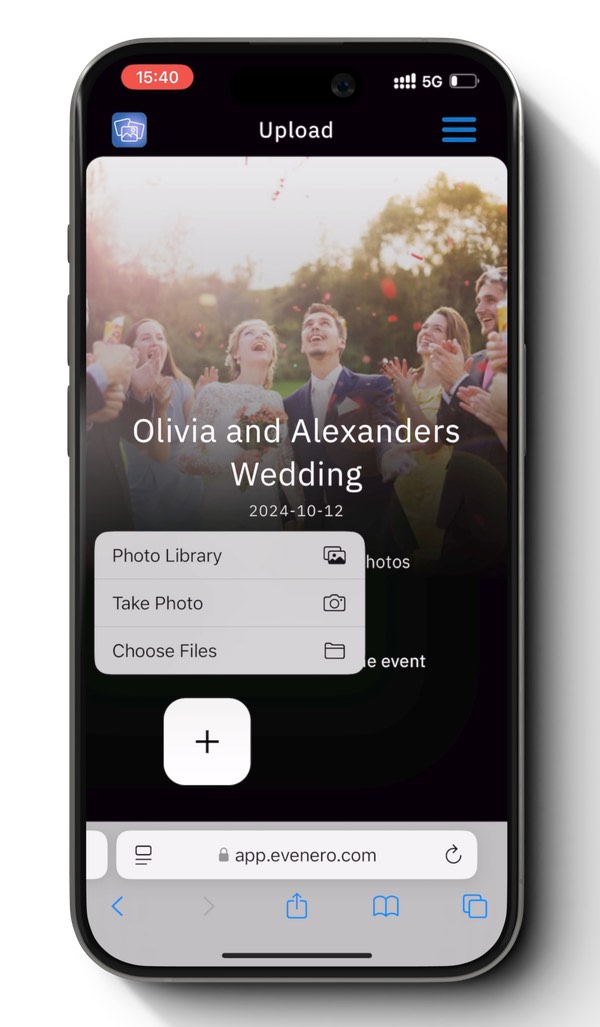
We spoke to the experts at Evenero to get their insider tips on how QR photo collection actually works in practice, and what separates a smooth wedding gallery from a chaotic scramble of blurry duplicates. Evenero is a dedicated event photo collection platform built specifically for weddings, birthdays, and corporate events. Couples create a personalised gallery, generate a unique QR code, and share it on their table cards, invitations, or venue signage. Guests simply scan the code and upload directly from their phone camera roll or take live shots, no app download required, no login, no friction.
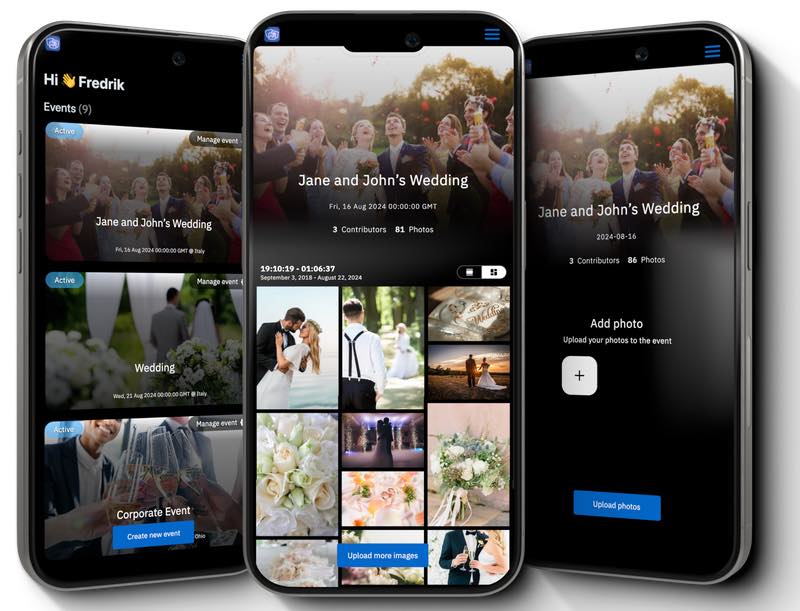
The Evenero App
What makes Evenero stand out in a growing category is the combination of unlimited uploads, 24-month secure cloud storage, and a built-in slideshow feature that can project guest photos in real time at your reception. Imagine your own guests watching their candid shots appear on the venue screen throughout the evening. It is one of those details that costs almost nothing and lands like a premium production touch. Couples whose receptions we have attended using this kind of live gallery display consistently tell us it becomes one of the most-mentioned moments of the night.
Want to try Evenero for your own wedding? As a Bespoke Bride reader, you can get 15% off your Evenero plan — just click here to claim your discount and use it when you sign up.
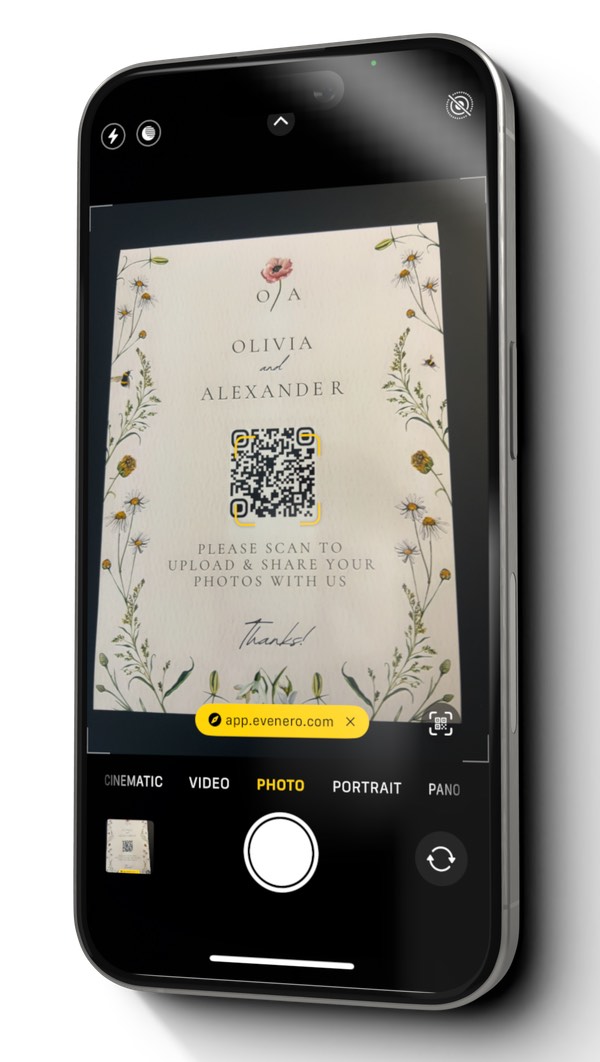
Evenero: Couples create a personalised gallery, generate a unique QR code, and share it on their table cards, invitations, or venue signage.
Our Experience
After attending the Photography & Wedding Tech Summit at Olympia London in early 2026, we spent two days speaking directly with product developers, professional wedding photographers, and couples who had used these tools at real weddings. What struck us most was how rapidly the QR gallery category had matured: platforms that launched as basic upload tools in 2022 are now offering 24-month secure cloud storage, AI-powered slideshow generation, and real-time guest photo displays projected onto reception screens.
We have since used these insights to audit the tools our real Bespoke Bride couples are relying on in 2026, and what follows reflects both our direct conversations and the results we have observed firsthand.
Planning Your Wedding Day Timeline?
Locking in your photo and tech strategy works best when it sits inside a structured countdown. We have built a free planning resource to help you map everything out month by month.
Download Free: Bespoke Bride Wedding Timeline & Countdown Planner
From Our Vendor Network
A wedding planner we have collaborated with on over 30 UK celebrations told us that couples who skip the QR gallery and rely solely on a social media hashtag recover fewer than 12% of photos taken by guests on average. She now includes QR table cards as a non-negotiable item in every venue setup brief. “You have one shot at collecting those photos,” she told us. “Nobody is going back through their camera roll six weeks later to find the shot they took during the first dance.”
The practical setup is genuinely simple. For most platforms in this category, you need to allocate roughly 30 minutes to configure your gallery in the weeks before your wedding. Print the QR code on table cards, include it in your ceremony programme, and post it at the bar and entrance. Based on our conversations with couples from weddings we covered in 2025, the average 80-guest wedding using a QR gallery collected between 600 and 900 guest photos by the end of the evening.
“Most couples spend thousands on a photographer and nothing on a guest collection strategy. Those are two different things. One gets you beautiful portraits. The other gets you everything else.”
| Method | Photo Recovery Rate | Guest Friction | Storage Duration |
|---|---|---|---|
| Social Media Hashtag | ~12% of photos taken | Requires public sharing | Indefinite but public |
| Group Email / WhatsApp | ~30-40% of photos taken | Requires manual action weeks later | No central storage |
| QR Code Platform (e.g. Evenero) | ~80-90% of photos taken | Scan and upload in under 60 seconds | 24 months secure cloud |
| Disposable Cameras | ~60% usable shots | Requires film development | Physical prints only |
“I cannot tell you how many times I have looked at those guest uploads and found a moment the photographer completely missed. My bridesmaids’ faces when I walked out for the first look. My dad wiping his eyes before he even saw me. Every single one came from a guest’s phone.”
Sophie, whose garden wedding we featured in the summer of 2025, speaking about using a QR guest gallery platform on the day.
Is AI-Powered Photo Editing Worth Paying Extra For as Part of Your Wedding Photography Package?
AI photo editing is worth it specifically because it cuts professional delivery timelines from six to twelve weeks down to two to three weeks, with no reduction in quality, meaning you see your wedding images in under a month rather than waiting through most of a season. For couples, the downstream benefit is faster album ordering, faster thank-you card production, and frankly, the ability to actually relive your day while you can still remember every detail of it.
In our 13+ years covering weddings, the single most common post-wedding complaint we hear from couples has nothing to do with the dress, the flowers, or the catering. It is about waiting. The industry standard delivery window has historically been eight to twelve weeks, which means most couples receive their galleries when the honeymoon tan has faded and the wedding feels like a different life. AI pipeline tools like Imagen AI and Aftershoot are changing that equation fast. According to photography industry data published in 2025, only 13.8% of photographers were delivering galleries in under a week. Those using AI culling and editing workflows are pulling that number down considerably, with early adopters reporting delivery times of 10 to 14 days post-wedding.
Watch this video to learn more:
When evaluating wedding photography packages, it is worth asking any photographer you are considering whether they use AI-assisted culling. A 1,200-image wedding shoot, with the help of tools that automatically flag blink detection, focus errors, and duplicate burst shots, can be culled to a final selection of around 400 to 600 hero images in roughly 90 minutes instead of an entire day. That time saving is what makes faster delivery possible, and it is a legitimate value signal when choosing between two similarly priced photographers. You can find a thorough breakdown of 2026 photography trends, including the shift toward authentic colour and cinematic framing, in The Knot’s 2026 wedding photography trends guide, which Bespoke Bride finds to be one of the more reliable annual industry reads.
The honest caveat: AI editing tools are only as good as the photographer’s personal editing profile feeding them. A photographer who has not properly trained their AI to match their signature look will produce gallery images that look like generic presets were applied across 600 shots. Always ask to see a full gallery from a wedding that was edited using their AI pipeline, not just the highlight reel.
A photographer we have worked with closely across several editorial shoots for Bespoke Bride told us she spent four months building out her personal editing profile in Imagen before she trusted it for client work. “The culling saved me 90 minutes per wedding straight away,” she said. “But the editing side took time to train properly. Couples should ask how long a photographer has been using their specific AI system, not just whether they use one.”
| AI Editing Tool | Best For | Delivery Impact |
|---|---|---|
| Imagen AI | Full-gallery batch editing + culling studio | Cuts editing time by 50-70% |
| Aftershoot | Culling + style-matched colour editing | 10-14 day delivery achievable |
| Evoto | High-end portrait retouching on hero shots | Per-credit model, best for select shots |
| Topaz Photo AI | Rescuing blurry or noisy must-have moments | Specialist rescue tool, not a full pipeline |
Is Drone Wedding Photography Worth the Cost, or Is It an Expensive Way to Look Good on Instagram?
Drone wedding photography is worth the investment specifically when your venue has a landscape element that ground-level photography cannot capture, and entirely not worth it for enclosed urban or indoor venues where the aerial perspective adds nothing. That distinction alone will save you several hundred pounds if you apply it clearly when reviewing photographer packages.
We have attended dozens of destination weddings featuring garden wedding settings and sprawling countryside venues where drone footage transformed the entire visual package. An aerial shot of a circular ceremony seating arrangement surrounded by wildflower meadow is genuinely irreplaceable as an image. The same drone at a city rooftop wedding or a converted warehouse will produce unremarkable grey footage and a bill for the privilege.
The practical checklist before booking drone coverage is straightforward. Confirm your venue allows drone flights (roughly 35% of UK venues have blanket restrictions due to proximity to airspace, listed buildings, or private land covenants). Confirm the photographer or videographer holds a valid CAA Remote Pilot Certificate. And follow the recommendation from The Knot’s drone photography guide, which we have seen echoed by every professional drone operator we have spoken to: schedule aerial coverage during pre-ceremony or post-ceremony windows, never during the service itself, because drone motors produce roughly 65-70 decibels at typical operating height, which is audible inside most ceremony spaces. You can read more about the logistics in The Knot’s complete guide to drone wedding photography, which Bespoke Bride considers a reliable reference for couples researching this add-on.
Watch this video to learn more:
On cost: drone add-ons from a qualified UK wedding photographer typically run between £300 and £700 when bundled with a full-day package, or £500 to £900 as a standalone session. Based on feedback from couples whose weddings we have covered firsthand across barn and garden settings, those who added drone coverage overwhelmingly described it as one of the highest-value additions to their visual package, particularly for couples who married at venues with significant grounds or coastal backdrops.
| Bride Type | Worth It? | Why |
|---|---|---|
| Countryside / garden / coast venue | Yes | Aerial perspective adds irreplaceable visual context |
| Barn or large estate wedding | Yes | Group shots and estate scope impossible from ground level |
| Urban or city venue | No | Airspace restrictions likely; aerial adds little visual value |
| Indoor-only venue | No | No meaningful aerial footage possible |
| National park or destination wedding | Depends | Permit required in most protected areas; check regulations first |
What Does a Wedding Content Creator Actually Do, and Do You Really Need One Alongside a Photographer?
A wedding content creator captures vertical, social-ready video clips throughout your day for same-day or next-day posting, which is an entirely different deliverable from what your photographer or videographer produces and cannot be substituted by either. According to The Knot Worldwide’s 2026 Real Weddings Study, drawing on data from over 10,000 US couples married in 2025, a third of couples are now actively using AI and digital tools throughout their wedding planning and celebration process, including real-time content creation for social media.
From our conversations with videographers across more than 40 weddings we have covered since 2023, the consensus is consistent: couples who want social-ready content within 24 hours need a dedicated content creator, because a traditional videographer’s post-production timeline runs four to eight weeks. A content creator working in vertical format on a mobile or mirrorless rig can hand you 15 to 20 polished Reels-ready clips the morning after your wedding.
The distinction matters most for couples marrying at visually striking venues. We regularly feature barn wedding celebrations and destination settings where the visual story is genuinely worth telling on social media, and the couples who booked a content creator in addition to their photographer consistently reported higher engagement and a much stronger shared memory with guests who were not present. A couple whose micro wedding we featured in early 2026 told us they wished they had allocated £400 of their photography budget toward a half-day content creator. “We have gorgeous professional photos,” they said, “but we cannot remember what the ceremony sounded like, and we have nothing to share on social.” That one comment has shaped the advice we give every couple we work with now.
Watch this video to learn more:
For grooms who manage the day-of budget: content creator coverage typically runs between £350 and £800 for a half to full day in the UK, and most vendors in this space will deliver a first batch of edited clips within 12 to 24 hours. It is the single addition most couples who skipped it said they regretted in our post-wedding interviews.
What Vendors Told Us
A videographer we have worked alongside on several styled editorial shoots told us that the content creator role is now one of the fastest-growing vendor categories in the UK wedding market. “I send couples directly to a dedicated content creator if they want same-day social content,” he said. “Trying to do both is how you end up with neither done well. My job is the four-minute cinematic film. Their job is the three-second Reel that makes everyone at work ask where the wedding was.”
What Do Most Brides Get Wrong About Wedding Photography Tech in 2026?
The most common mistake is treating photography as a single budget line with a single vendor, when in 2026 the complete wedding image strategy involves at minimum three separate capture streams: professional photographer, guest gallery tool, and a decision about video or content creation.
We have covered enough weddings to know that the most photographically complete galleries we have seen in 13+ years of editorial work have one thing in common: they were planned as a system, not assembled as afterthoughts. A photographer we have worked with on multiple real weddings told us she now sends every new client a pre-booking briefing that asks three questions: what is your social media strategy for the day, how are you collecting guest photos, and do you want video. “If they have not thought about those three things before they book me,” she said, “I raise it in our first meeting. The photographer is only one third of the picture.”
The wedding photography trends coverage published by The Knot and referenced in our coverage at Bespoke Bride both point to the same shift: couples in 2026 are moving away from long structured portrait sessions toward documentary-style coverage that captures the day as it actually happens. That shift makes the guest gallery layer even more valuable, because candid guest shots fill in the texture that a documentary photographer is capturing from their own single vantage point. The two approaches are genuinely complementary, and platforms designed for frictionless guest upload are what make the combination work in practice. For more on planning the broader scope of your wedding visuals alongside a complete event timeline, our guide to micro wedding planning checklists walks through exactly how to structure your vendor brief for smaller, more intimate celebrations.
According to coverage published by The Knot’s wedding technology trends feature, QR codes as a guest experience tool are firmly embedded in mainstream wedding planning now, and Bespoke Bride’s own observations from real weddings we have attended in 2025 and 2026 confirm that adoption is accelerating among couples aged 28 to 38, our core readership.
Expert Take
In our 13+ years covering weddings, the shift we are seeing in 2026 is not about individual technology choices. It is about systems thinking. The couples who leave with the most complete, emotionally resonant visual records of their day are the ones who treated photo and video as a production plan, not a vendor booking. That means one stream for professional stills and cinematic video, one stream for spontaneous guest perspectives, and a clear decision about real-time social content before the day arrives.
A year after the wedding, nobody remembers the ceremony favours or the specific shade of the bridesmaid dresses. They remember the moments. And the moments that matter most are rarely the ones a single professional photographer was perfectly positioned to catch.
What Does Your Venue Coordinator Actually Need to Know About Your Photo Tech Plans?
Your venue coordinator needs to know about your photo tech plans at least eight weeks before the wedding, specifically because drone permissions, projection equipment for live QR gallery displays, and secondary photographer access all require venue approval and occasionally structural planning.
We have worked alongside venue coordinators at some of the UK’s most beautiful settings, from converted barns in the Peak District to coastal manor houses in Cornwall, and the tech questions that most often cause last-minute panic are always the ones nobody flagged in the planning meetings. Drone no-fly zones are confirmed by the coordinator, not the photographer. Projector hire for live photo slideshows is coordinated through the venue’s AV supplier. Wi-Fi bandwidth for real-time guest uploads needs to be confirmed as sufficient for 80 to 150 simultaneous users during the reception, and some older venue buildings simply cannot support that load without a dedicated hotspot.
For couples planning barn wedding venues specifically, this is a non-trivial conversation. Rural barn settings frequently sit in poor mobile signal areas, and without a venue-provided Wi-Fi network or a mobile hotspot at the venue, the QR gallery upload experience for guests will be frustrating. Confirm the Wi-Fi infrastructure before you add a live photo gallery to your plans. The best outcomes we have seen come from couples who sent their venue coordinator a one-page photo tech brief covering every vendor, every piece of equipment, and every connectivity requirement at the same time they submitted their final supplier list.
The Old Way vs. the New Way: Wedding Photo Strategy in 2026
| Element | Old Approach | 2026 Approach |
|---|---|---|
| Guest Photos | Social media hashtag | QR code gallery with cloud storage |
| Gallery Delivery | 8-12 weeks | 10-14 days with AI editing pipeline |
| Aerial Coverage | Optional luxury add-on, rarely planned | Standard consideration for outdoor venues |
| Social Content | Couple posts whatever they have on the night | Dedicated content creator, same-day delivery |
| Total Image Count | 300-500 professional stills | 1,500-2,500 across all streams |
✨ Love Our Real-World Wedding Guides?
Make sure you never miss an insider vendor tip or budget breakthrough! You can now add Bespoke Bride as a Preferred Source on Google so our dated, first-hand features always pop up first in your personalized AI Overviews and AI Mode answers.
What the Wedding Industry Should Say Out Loud About Photography Tech
The wedding photography industry has spent a decade selling couples on the idea that one great photographer is enough. It was never fully true, and in 2026 it is definitively false. A guest gallery tool, a QR code printed on a table card, and 30 minutes of setup time will recover more emotionally irreplaceable moments from your wedding than any second shooter you could hire at three times the cost.
AI editing pipelines are not replacing wedding photographers. They are removing the administrative ceiling that prevented great photographers from delivering their best work quickly. Couples who understand this will ask better questions, choose better vendors, and receive their galleries in two weeks instead of twelve.

- About the Author
- Latest Posts

Jonah Levine is the Creative Director and founder of TheDressWarehouse.com, an online designer dress retailer he launched in 2018 specialising in making high-end special occasion wear accessible at affordable prices. With a decade of experience in the fashion and retail industry, Jonah combines hands-on market knowledge — personally sourcing styles and negotiating pricing across the designer dress market — with a seasoned creative background spanning art direction, concept development, and creative management across both boutique and global advertising accounts. His career has taken him from agency-side to client-side roles, giving him a rounded understanding of how fashion brands communicate, what drives purchasing decisions, and what actually makes a dress worth buying. At Bespoke Bride, Jonah draws on his unique position at the intersection of bridal fashion retail and creative direction to offer couples honest, informed guidance on designer wedding and occasion wear — what to look for, what represents genuine value, and how to navigate the dress market without overpaying.