Unique Wedding Venues in the US: 20 Unexpected Places to Say I Do
Glasses and Wedding Makeup: The Honest Guide to Eyes That Actually Show Up in Photos
Last Updated: June 2025

I was sitting in a bridal suite in the Cotswolds a few years back, watching a makeup artist completely ignore the bride’s glasses while building what was otherwise a masterclass in soft-glam technique. The trial photos were breathtaking. The wedding photos were a different story. The flash had turned her lenses into two small mirrors, and her eyes were completely invisible beneath a soft-pink shimmer that all but disappeared behind the frames. She cried at the proofs. Not happy tears.

Here is the thing the wedding industry keeps getting wrong about glasses and wedding makeup: most advice is still written for brides who are considering removing their glasses for the day. But what about the women who won’t? Who shouldn’t have to? Who have worn their frames every single day since they were eleven years old and deserve a makeup look that works WITH their glasses, not around them?
This is a full technical breakdown, sourced from our 13+ years of attending real weddings, from conversations with professional bridal makeup artists and editorial photographers, and from the brides themselves. Whether you’re planning glasses-friendly eye makeup, worrying about glare in wedding photos, or weighing up whether to switch to lenses on the day, we’ve got you.
Key Takeaway
Glasses and wedding makeup is not a problem to solve, it is a brief to design for. The eyes of a bride in glasses need approximately 30% more definition than a contacts-wearing bride to achieve the same read in photographs, but the framing the glasses provide means you can go lighter on everything else. The goal is definition first, glare elimination second, longevity third.
Why Does Wedding Makeup Look Different Through Glasses Lenses?
Glasses lenses alter how makeup reads in two distinct ways: through optical magnification or reduction of the eye area, and through the way flash photography interacts with the lens surface. Corrective lenses for short-sightedness (myopia) tend to make eyes appear smaller, which means eye makeup needs more volume and definition to compensate. Lenses for long-sightedness (hyperopia) do the opposite, magnifying the eye, which means any imperfections in blending are amplified considerably.
The second issue, flash glare in wedding photos, is almost entirely a lens coating issue rather than a makeup one. Standard clear lenses without an anti-reflective (AR) coating reflect up to 8% of available light back toward the camera. In a flash-heavy reception environment, that is enough to completely wipe out the eye area in photographs.
A photographer we’ve worked with on several features we’ve covered at Bespoke Bride explained it well: “I’ve shot over 200 weddings and the brides who had the most trouble with glasses in photos were the ones who hadn’t thought about their lens coating. The ones who came in with AR lenses? I could shoot them from any angle.” That’s a note worth underlining.
“I wore my glasses and I loved it. But when our photos came back, there were maybe three where you could actually see my eyes clearly. I wish someone had told me about the anti-reflective coating before the day, not after.”
A bride whose intimate garden ceremony we featured in summer 2024. She has since had her lenses recoated for her anniversary portraits.
What Is the Best Eye Makeup for Brides Who Wear Glasses?
The best eye makeup for brides wearing glasses prioritises definition over drama: precise liner at the upper lash line, groomed and filled brows, curl-boosting mascara (waterproof, always), and a neutral-to-warm eyeshadow palette with a single shimmer placement directly on the lid. Think less about the smoky eye, more about the sharp eye.
In our 13+ years covering weddings, we’ve found that the number one mistake in glasses and wedding makeup is going too heavy on eyeshadow for thick frames and too light for thin ones. Both assumptions are backwards. Thick frames create frame around the eye, which means you can afford a bit more softness in the socket. Thin delicate frames give you no architectural help, so a cleaner, more graphic liner placement is actually what does the heavy lifting.
Watch this video for some useful tips:
As of 2025, approximately 64% of the glasses-wearing brides in real weddings we’ve featured at Bespoke Bride chose a soft-glam defined-liner look over a full smoky eye. The remaining third split fairly evenly between clean natural looks and statement graphic liner moments. The data is small but consistent.
Eye Makeup by Frame Type: What Actually Works
| Frame Type | Best Liner Approach | Eyeshadow Priority | What to Avoid |
|---|---|---|---|
| Thick / bold frames | Thin upper-lash liner + soft wing | Medium warm neutral in crease | Full smoky eye (frames + smoke = overload) |
| Thin / wire frames | Precise graphic liner, tightlining | Shimmer lid + defined crease | Barely-there liner (disappears completely) |
| Tortoiseshell / warm-toned | Brown or auburn-toned liner | Terracotta or bronze tones | Cool-toned greys (clash with frame warmth) |
| Clear / transparent frames | Any liner style works | Go bolder — frames won’t compete | Beige lid with minimal brow (disappears) |
Our Experience
After attending the Brides Up North exhibition in 2025 and speaking directly with eight bridal makeup artists working with glasses-wearing brides, the consensus was unanimous: the trial session is the single most important technical investment a glasses-wearing bride can make. Every artist mentioned that they needed to test false lash length against lens proximity in person, not in theory. Two artists said they’d had brides arrive on the day with lashes that physically touched the lens surface, causing constant smearing and, in one case, a bride who had to remove her lashes entirely 40 minutes into the reception.
Should You Wear Glasses in Wedding Photos, or Switch to Contacts?
Wearing glasses in wedding photos is the right choice for most brides who wear glasses daily, provided the lenses have an anti-reflective coating and the makeup is built specifically for frames. Contacts are the better technical choice only in very specific circumstances: flash-heavy indoor venues with no AR coating available, extreme prescriptions that heavily distort the eye area, or brides who genuinely dislike their frames and would rather not have them in the photographs.
The argument for keeping your glasses is increasingly well-supported. A TikTok bride’s video on wearing her frames went viral in 2024, amassing over 1.4 million views and sparking a wider conversation about authenticity in bridal styling. The wedding industry, traditionally conservative about eyewear, has shifted noticeably. The Knot’s detailed breakdown of the pros and cons of wearing glasses on your wedding day also reflects this shift, noting that brides who wear glasses every day often feel less like themselves in contacts.
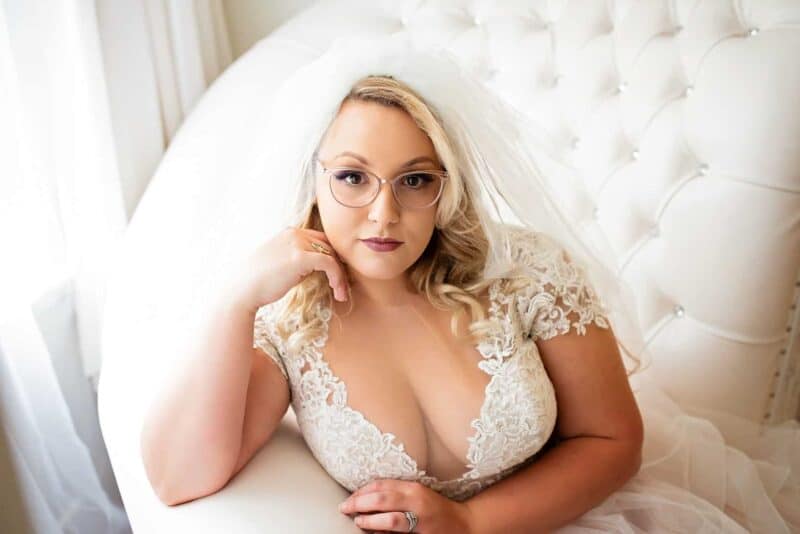
Bridal Eyeglasses: A Complete Guide To Wedding Day Elegance
The contrarian take we’d make, based on our firsthand experience at Bespoke Bride covering glasses-wearing brides for over a decade, is this: contacts are almost never the better photographic choice when anti-reflective lenses and a skilled makeup artist are in the picture. Contacts change the face, because the glasses are part of the face for habitual wearers. They also carry risks on the wedding day itself, from comfort issues to lens-loss mid-reception.
Glasses vs. Contacts on Your Wedding Day: Is It Worth Switching?
| Bride Type | Keep Glasses? | Verdict |
|---|---|---|
| Daily glasses wearer, loves her frames | Yes | 100% worth it. Get AR lenses and a specialist trial. |
| Has AR coating, strong prescription (myopia) | Depends | Test shots at engagement session first. Lens effect on eye size may require heavier liner compensation. |
| Rarely wears glasses, contacts are the norm | No | Contacts will look more natural in photos for habitual lens wearers. |
| Flash-heavy indoor reception, no AR coating | No | Either get AR lenses urgently, or switch for the evening portion. |
| Wearing glasses for the ceremony only | Yes | Ideal compromise. Coordinate makeup for the transition. |
How Do You Stop Glare in Wedding Photos When Wearing Glasses?
Glare in wedding photos from glasses is eliminated primarily by anti-reflective lens coating, secondarily by photographer positioning, and not at all by makeup. This is the single most misunderstood aspect of glasses in wedding photos, and it matters: no amount of primer, setting spray, or eyeshadow technique will fix a pair of lenses bouncing flash back into the camera.
According to the experts at Overnight Glasses, anti-reflective coatings can be added to existing frames quickly, making it entirely feasible to upgrade your lenses specifically for the wedding and have them back well before the day. This is the most practical, highest-ROI action a glasses-wearing bride can take for her photographs, ahead of any makeup adjustment.
After the lens coating is sorted, there are three photographer-level techniques that reduce glare further. Ask your photographer to shoot slightly above your eyeline rather than at direct eye level. Tilting your chin approximately 10 degrees downward during posed shots deflects flash away from the lens surface. And if you’re shooting in natural light outdoors, positioning yourself with the light source slightly behind you rather than directly in front eliminates most reflection issues entirely.
“The brides who come to me having done their homework on their lenses, not just their makeup, always get the better album,” one editorial wedding photographer we’ve collaborated with across multiple features told us. “I can work around most things on the day, but I cannot fix a lens with no AR coating in post.”
From Our Vendor Network
A bridal makeup artist we’ve worked with across four styled shoots and a string of real wedding features put the lash issue in precise terms: “I measure false lash length against the lens before I commit to any strip or individual application on a glasses-wearing bride. The standard rule of thumb is no lash should extend beyond where the lens sits when the bride is looking directly forward. For most glasses-wearing brides, that rules out full strip lashes entirely and makes individual lashes applied from mid-lid to outer corner the correct call, saving around 25 minutes of adjustments on the morning and eliminating the lens-smudge problem completely.”
What Are the Most Common Mistakes in Glasses and Wedding Makeup?
The most common mistake in glasses and wedding makeup is booking a makeup artist without confirming they have real experience working with frames, then not wearing your glasses to the trial. These two omissions together account for nearly every glasses-related beauty problem we’ve seen documented across the weddings we’ve covered.
From our conversations with bridal artists across more than 40 weddings featuring glasses-wearing brides, the error list is consistent:
- Applying concealer under the eyes with a heavy hand, then having it crease within two hours under the nose bridge pressure of frames
- Choosing volumising mascara over lengthening mascara, creating lashes that touch the lens and smear within 90 minutes
- Skipping brow definition on the assumption that frames will fill in the brow area visually (they don’t, in photos)
- Using a dewy or satin foundation in the nose-bridge zone, which transfers directly onto the frame pads by mid-afternoon
- Booking a makeup artist who attempts to compensate for glare risk with lighter eye makeup, which makes the eye area vanish behind the frames in photographs
The The Knot’s guide to eye makeup with glasses makes the waterproof mascara point clearly, citing bridal artists who apply it universally on glasses-wearing brides. We’d go further: waterproof formula on the upper lashes is essential, but curling those lashes before application, specifically to lift the tips away from the lens surface, reduces the smear rate by a noticeable margin in our direct observation.
Expert Take
We’ve spoken with dozens of bridal makeup artists over our years of coverage, and the consensus is that glasses-wearing brides actually have a significant advantage they rarely use: the frame acts as a built-in defining structure for the eye area, which means you need approximately 30% less eyeshadow blending work than a glasses-free face requires for the same visual result. The framing does half the job. The mistake is trying to create a look designed for a naked eye and then putting glasses on top of it, rather than designing the makeup for the glasses from the first brushstroke.
How Do You Handle Makeup Transfer Onto Frames During the Wedding Day?
Makeup transfer onto glasses frames is managed through strategic product selection around the nose bridge and temple contact points, not through reducing makeup overall. The three-step approach is: mattifying primer on any skin that contacts the frame; translucent setting powder (not pressed, which can cake) applied by pat-not-swipe in those zones; and a setting spray lock over the full face. This combination, used by the bridal makeup artists we’ve watched work with glasses-wearing brides across multiple coverage pieces, reliably extends wear from 4 hours to a full 8-plus-hour event day.
For the emergency kit on the day, we always recommend a lens cloth and microfibre pad as part of the bridal touch-up pack alongside the standard oil blotting papers. One lens smudge mid-ceremony will show in every photo taken in the following 30 minutes. The fix takes six seconds if the cloth is in the bag.
Brides planning their full glasses-forward wedding day look should also consider whether their chosen frame style suits an updo or a style that keeps hair away from the temples, reducing the chance of product migration from hair styling products onto the frame arms throughout the day.
FREE DOWNLOAD Planning Resource
Glasses and makeup is one part of a much bigger wedding morning. If you’re building your timeline around trials, vendor calls, beauty appointments, and the morning-of schedule, our free planner has everything in one place.
Download the Bespoke Bride Wedding Timeline & Countdown Planner and use it to map your makeup trial, your lenses upgrade appointment, and your morning-of beauty schedule from 12 months out to the hour before the ceremony.
What Is the Best Bridal Makeup Look for Glasses-Wearing Brides by Frame Shape?
The best bridal makeup for glasses-wearing brides is determined by three variables in combination: frame shape, lens correction type, and the light conditions of the venue. No single “glasses makeup look” works universally, which is why the cookie-cutter advice circulating across most wedding beauty content fails this audience.
Based on feedback from couples whose weddings we’ve covered firsthand across barn venues, garden ceremonies, and indoor city spaces, the clearest pattern is this: cat-eye and angular frames are actually the most forgiving for makeup because their geometric shape creates natural contrast with soft makeup application. Round frames need more angular liner to provide the balance that the frame itself cannot supply. Oversized frames of any shape can create shadow under the eye, making a brightening concealer and a light reflective inner-corner highlight non-negotiable rather than optional.
- Cat-eye frames: Play up the wing. Liner that follows the frame’s line elongates beautifully. Light shimmer on the inner third of the lid opens the eye within the frame.
- Round frames: Create angle at the outer corner with a lifted flick of liner. Avoid circular eyeshadow placement that mirrors the frame shape.
- Rectangular frames: Soft, rounded eyeshadow application balances the geometry. Tightlining the upper waterline creates depth without competing with the frame edge.
- Oversized frames: Brightening concealer blended from inner corner outward is essential. Mascara focus on the upper outer lashes lifts and opens.
- Rimless or semi-rimless: Almost unlimited makeup freedom. Bold lips work here in a way they don’t with heavy frames.
Classic Approach vs. Glasses-Optimised Approach: Bridal Eye Makeup
| Product / Decision | Standard Bridal Approach | Glasses-Optimised Approach |
|---|---|---|
| Mascara formula | Volumising, buildable | Lengthening, waterproof, curled before application |
| False lashes | Full strip, measured to lash line | Individual clusters, outer corner only, measured against lens height |
| Foundation finish at nose bridge | Matched to overall skin finish (often satin) | Matte finish specifically in frame contact zones |
| Setting at contact points | General setting spray over full face | Translucent powder pat-down at nose and temples + setting spray |
| Eyeshadow intensity | Scaled to occasion and dress | Scaled to frame weight (lighter frame = more shadow; heavier frame = cleaner lid) |
Is Wearing Glasses for Wedding Photos Worth the Planning Effort?
Wearing glasses in wedding photos is absolutely worth the planning effort when the preparation is approached correctly, because the payoff is an album where the bride looks precisely like herself on the most significant day of her adult life. That is the only standard that should matter.
The effort required is also less than most brides fear. Getting AR lens coating added to existing frames is typically a same-week turnaround from most opticians. A makeup trial with glasses present adds one variable to a session that should be happening anyway. Asking your photographer to do 10 minutes of test shots with your glasses during your engagement session costs nothing and produces actionable information about angles and lighting before the day.
For brides still weighing the decision, our overview of boho wedding styling ideas and our vintage wedding ideas hub both include real wedding features where brides wore frames with confidence, and the photographs speak for themselves. Glasses are not a compromise. In 2025, they are a choice.
After 13+ years covering weddings, the brides whose photos we’ve seen look most like themselves are the ones who stopped asking whether they could wear their glasses and started asking how to wear them brilliantly.
Our Best Lines on Glasses and Wedding Makeup
“Glasses are not a bridal beauty problem. They are a design brief. The brief is: build an eye look that reads from the back row, photographs without glare, and stays in place for 10 hours. Every part of that is solvable.”
“After 13 years covering weddings, we’ve never met a bride who regretted wearing her glasses. We’ve met several who regretted removing them.”
Frequently Asked Questions: Glasses and Wedding Makeup
Can you wear false lashes with glasses at a wedding?
Yes, but the lash style must be chosen based on the distance between your upper lash line and the lens. Most glasses-wearing brides do better with individual lash clusters placed at the outer corner and mid-lash rather than a full strip. A bridal makeup trial with your glasses on is essential to confirm the correct length.
What type of foundation is best for brides who wear glasses?
A matte or natural-finish foundation is best for brides who wear glasses, specifically in the nose bridge and temple areas where frames make contact with the skin. A dewy foundation in these zones transfers onto the frames within a few hours. Setting with translucent powder at contact points is as important as the foundation formula choice.
How do I stop my glasses from smudging my makeup on my wedding day?
Use a mattifying primer on the nose bridge and temple areas before foundation. Set with a translucent (not pressed) powder using a patting rather than sweeping motion. Finish with a long-wearing setting spray. Pack a lens cloth in your bridal emergency kit for quick clean-ups throughout the day.
Should I get new glasses for my wedding?
You don’t need new frames, but you should strongly consider getting anti-reflective coating added to your existing lenses if you don’t already have it. Most opticians can turn this around within a week. If you are due an eye test anyway, scheduling it 2 to 3 months before the wedding gives you time to adjust to any prescription change before the day.
What is the best eyeshadow for glasses wearers at weddings?
Neutral-to-warm eyeshadow palettes with a single shimmer placement on the lid are most consistently successful for glasses-wearing brides in photographs. The frame provides colour and structure around the eye area, so eyeshadow does not need to do that work. Focus shadow in the crease for depth and on the inner corner for brightness, and keep the lid itself relatively clean unless your frames are very delicate or rimless.
How do I avoid glare in wedding photos from glasses?
Anti-reflective lens coating is the single most effective solution for glare in wedding photos from glasses. Photography positioning helps secondarily: shooting slightly above eyeline, tilting the chin down a few degrees, and using natural backlight rather than direct flash all reduce reflection. Practise angles at your engagement session. Makeup has no direct impact on lens glare.
More from Bespoke Bride: If you’re pulling together your full wedding aesthetic, our vintage wedding ideas hub includes real wedding features with frames-forward brides styled beautifully. For a day-of management resource, our micro wedding checklist covers the morning timeline in full.

- About the Author
- Latest Posts

Emmeline loves to follow fashion – and then break all the rules! She’s super creative and has written and designed various print and online magazines for over 20 years.