

Wedding Invitation RSVP Tracking: The Part Nobody Prepares For (And How to Get It Right)
WEDDING PLANNING TIMELINE: MONTH-BY-MONTH GUIDE FOR 2026
A wedding planning timeline is the difference between feeling in control and feeling overwhelmed. It is not about doing everything — it is about doing the right things at the right time, so no decision sneaks up on you at the worst possible moment.

This guide maps out every major task across a full 12–18 month timeline, broken into clear phases. Whether you are just engaged or already deep into planning, you can jump to wherever you are right now and work forward. Every phase includes what to prioritise, what can wait, and the deadlines that actually matter.
This timeline is part of our complete wedding planning checklist — a comprehensive hub covering budgets, vendor booking, checklists for every wedding style, and a curated map of wedding planning resources across the US. Later on you can also learn how much a wedding planner costs in 2026!

12–18 Months Out: Lay the Foundation
This is the phase where you make the decisions that shape everything. Budget, venue, and guest count are the three pillars — once they are set, every other choice becomes simpler. Resist the urge to jump ahead to flowers and place settings before these are locked down.
The single most important task in this phase: book your venue. It determines your date, your guest count ceiling, your catering options, and often your entire décor direction.
Set your total budget — Sit down with your partner and anyone contributing financially. Agree on a hard number before you look at a single venue. Knowing your priorities early (food, photography, venue, flowers) helps you allocate wisely. For a detailed breakdown of where the money goes, see our average wedding cost 2026 guide, and for guidance on scaling cost to your guest list, see wedding budget by guest count.
Draft your guest list — Start with must-haves: immediate family, closest friends, and anyone whose absence would genuinely be felt. Expand from there only if budget allows. A rough headcount is essential before you can meaningfully compare venues. Every guest adds $150–$250 to your total cost.
Research and book your venue — Visit at least 3–5 venues. Ask about capacity, catering (in-house or outside vendors), rain backup, parking, noise restrictions, and what is included. Popular venues book 12–18 months out for peak season dates, so move quickly once you have found the right one. For venue inspiration, explore our guides to barn weddings, garden weddings, beach weddings, and micro wedding venues. For some inspiration, check out our list of best wedding venues in the US, our best wedding venues in the US 2026 and our list of the most unique wedding venues we think are out there 🙂
Book your photographer — This is the one vendor most couples wish they had booked earlier. Great wedding photographers book 12–18 months out, and their work is the only thing that lasts from your wedding day. Look at full galleries, not just highlight reels. For guidance on choosing a photography approach, explore our wedding photography styles guide.
Also in this phase: Decide your wedding style and vision. Choose your wedding party. Hire a wedding planner or day-of coordinator if using one. Create a wedding website with your date, location, and travel info. Set up a planning hub — a shared Google Drive folder, spreadsheet, or planning app. Consider wedding insurance. Later on you can check out these questions to ask before signing a planner contract.
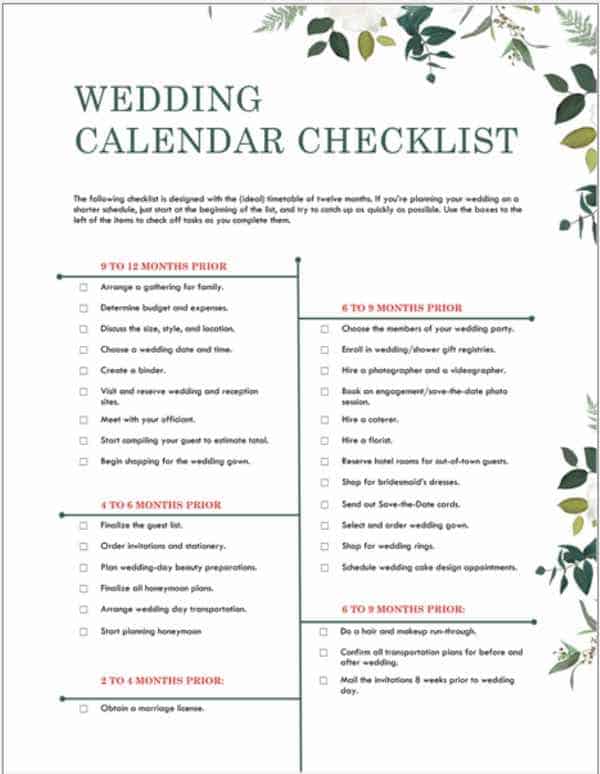
Wedding Calendar Checklist.
9–11 Months Out: Build Your Vendor Team
Your venue is locked. Now you are assembling the people who will bring your day to life. This is the phase where creative decisions start — flowers, music, food, and the dress.
Book your caterer — If your venue has in-house catering, confirm menus and per-head pricing. If you are bringing in outside catering, book now and schedule a tasting for later. Catering typically accounts for 35–40% of your total budget, making it the single largest line item.
Book your entertainment — DJ, live band, or both. Music sets the emotional tone for every part of the day — ceremony, cocktail hour, dinner, and dancing. In-demand bands and DJs book 9–12 months out for Saturday dates.
Book your florist — Discuss seasonal availability, your colour palette, and must-have arrangements (bouquet, ceremony arch, centrepieces). Seasonal flowers cost significantly less than out-of-season imports. For inspiration and DIY options, explore our wedding flower ideas hub and best places to buy wholesale flowers.
Start dress shopping — Allow 6–9 months from purchase to wedding day for ordering, shipping, and 2–3 rounds of alterations. Bring your closest confidant (not a committee), wear nude undergarments, and be open to trying silhouettes you had not considered.
Also in this phase: Book your videographer. Send save-the-dates — especially for destination or holiday-weekend weddings. Research and book your officiant. Start thinking about ceremony structure. Reserve hotel room blocks. Plan your engagement photoshoot. For help choosing between vendors, see our guide on how to compare wedding suppliers.
6–8 Months Out: Refine the Details
The big pieces are in place. Now you are refining the creative vision, locking in details, and making sure nothing important falls through the cracks.
Key tasks: Order your wedding dress if you have not already. Choose bridesmaids’ and groomsmen’s attire. Book hair and makeup and schedule a trial. Finalise your colour palette and décor concept with your florist. Book rentals — chairs, linens, lighting, tableware, tent if outdoor. Design your invitation suite. Plan ceremony music and processional order. Begin writing personal vows. Book transportation. Book your cake or dessert provider. Start planning your honeymoon and check passport and visa requirements.
For décor inspiration at this stage, explore our guides: DIY Wedding Decor Ideas · Boho Wedding Ideas · Vintage Wedding Ideas
4–5 Months Out: Invitations Go Out
This is when your wedding starts to feel real. Invitations are in the mail, menus are being tasted, and the timeline is taking shape.
Key tasks: Order and send wedding invitations — set your RSVP deadline for one month before the wedding. Schedule a menu tasting with your caterer. Finalise your bar plan — open bar, limited bar, or signature cocktails. Order wedding bands. Book your rehearsal dinner venue. Plan pre-wedding events: bridal shower, bachelor and bachelorette parties. Start your seating chart — begin with groups, not individuals. Order personalised items: favours, signage, welcome bags. Confirm insurance and permits. Schedule dress fittings with your shoes and undergarments.
2–3 Months Out: Confirm Everything
The countdown is on. Most vendors are booked, your dress is being altered, and now it is about confirming, coordinating, and tying up loose ends.
Key tasks: Chase RSVPs from non-responders — a polite phone call or text is fine. Finalise your guest count and submit to your caterer. Complete your seating chart. Finalise ceremony details with your officiant — readings, vows, cues. Create your day-of timeline and share with every vendor. Order ceremony programs, menu cards, table numbers, and place cards. Finalise your photography shot list and share VIP names with your photographer. Break in your wedding shoes at home. Apply for your marriage licence — check your state’s timing requirements. Confirm all vendor contracts, arrival times, and points of contact. Prepare tips and final payments in clearly marked envelopes.
Final Month & Final Week: You Are Ready
The work is done. This final stretch is about confirming everything one last time, finishing personal touches, and letting yourself enjoy the anticipation.
Final month: Confirm every vendor — arrival time, setup time, access details, and your phone number. Do a final dress fitting. Have your hair and makeup trial if not already done. Finalise honeymoon plans and confirm bookings. Write thank-you speeches and toasts. Prepare a wedding-day emergency kit: bobby pins, safety pins, stain remover, pain relief, tissues, breath mints, sewing kit. Delegate day-of tasks to your wedding party or coordinator. Check the weather forecast and confirm your backup plan with your venue. Pick up your marriage licence.
Final week: Confirm final headcount with caterer and venue. Give your DJ or band your must-play and do-not-play lists. Hand off tip envelopes and final payments to your best man, maid of honour, or coordinator. Lay out everything you need for the day — dress, accessories, rings, licence. Assign someone to pack up gifts and belongings after the reception. Attend your rehearsal and rehearsal dinner. Get a good night’s sleep.
The two things you absolutely cannot forget on your wedding day: the rings and the marriage licence. Assign a specific person to be responsible for each.
Watch this video to learn more tips:
Quick-Reference Wedding Planning Timeline
Bookmark this table for a quick at-a-glance reference of the most critical deadlines.
| When | Critical Tasks |
|---|---|
| 12–18 months | Set budget, draft guest list, book venue, book photographer |
| 9–11 months | Book caterer, DJ/band, florist, videographer; start dress shopping; send save-the-dates |
| 6–8 months | Order dress, book hair/makeup, book rentals, design invitations, book cake, plan honeymoon |
| 4–5 months | Send invitations, menu tasting, order wedding bands, book rehearsal dinner, start seating chart |
| 2–3 months | Chase RSVPs, finalise guest count, create day-of timeline, apply for marriage licence |
| 1 month | Confirm all vendors, final dress fitting, prepare emergency kit, write speeches |
| Final week | Confirm headcount, hand off tips, lay out everything, rehearsal, breathe |
What If You Have Less Than 12 Months?
Not everyone has a year-plus runway, and that is completely fine. Here is how to compress the timeline:
6–9 months: Entirely achievable for most weddings. Combine the first two phases — set your budget and book venue, photographer, and caterer in the same week. Move to entertainment and florist immediately after. The biggest constraint is dress ordering, so prioritise that early or consider sample sales and trunk shows.
3–6 months: Best suited for micro weddings (under 50 guests) or couples who are flexible on date and venue. Fewer guests means fewer vendor constraints, simpler logistics, and more available dates. Our micro wedding checklist is built specifically for this compressed timeline.
Under 3 months: You are in elopement territory — and that is a beautiful choice. Focus on the officiant, a stunning location, a photographer, and each other. Our guide to where to elope in the US covers 20 breathtaking locations.
Peak Season vs. Off-Peak: How It Affects Your Timeline
If you are planning a Saturday wedding between May and October, you are competing with the majority of couples in the country for the same vendors. Move every booking deadline up by 2–3 months to stay ahead.
Off-peak weddings (November–April, or Fridays and Sundays) give you more flexibility, more availability, and often 15–30% lower pricing. The timeline above still applies, but you will have more breathing room at each stage.
For more on how timing affects cost, see our wedding budget hub.
Your Next Steps
This timeline gives you the structure. For deeper dives into each topic, explore these resources:
Complete Wedding Planning Checklist — the full hub with budget tables, vendor order, style guides, and FAQ
Download the Full Planning Guide — our 15-section printable guide with checkbox checklists
Wedding Planning Resources Map — bridal salons, expos, all-inclusive venues, and flower markets across the US
Average Wedding Cost 2026 — what couples are actually spending, broken down by category and region
Wedding Budget by Guest Count — how much your wedding costs at 25, 50, 100, 150, and 200+ guests
Wedding Planning Timeline FAQ
How long does it take to plan a wedding?
Most full-size weddings (100+ guests) take 12–18 months to plan comfortably. Micro weddings with fewer than 50 guests can be planned in 3–6 months. Elopements can come together in a matter of weeks. The key factors are your flexibility on date and venue, and how quickly you make decisions.
What is the first thing I should do when I get engaged?
Celebrate. Then, within the first few weeks, have the budget conversation with your partner and anyone contributing financially. Once you have a number and a rough guest count, start looking at venues. Everything else flows from there.
What vendors book up the fastest?
Venues and photographers book fastest — 12–18 months out for popular dates. Bands and DJs follow at 9–12 months. Caterers and florists typically have more availability but should still be booked 8–12 months out for peak season weddings.
When should I send save-the-dates vs. invitations?
Save-the-dates go out 8–12 months before the wedding — earlier for destination weddings. Formal invitations are sent 6–8 weeks before the wedding, with the RSVP deadline set for 3–4 weeks before.
Can I plan a wedding in 6 months?
Yes — especially for micro weddings with fewer than 50 guests. You will need to combine the first two planning phases, prioritise dress ordering early, and be flexible on date and venue. For a checklist built for this timeline, see our micro wedding checklist.
What is a wedding planning timeline template?
A wedding planning timeline template is a structured, month-by-month schedule of every task needed to plan your wedding. You can use this page as your template, or download our full printable wedding planning guide with checkbox checklists for every phase.

- About the Author
- Latest Posts

Emmeline loves to follow fashion – and then break all the rules! She’s super creative and has written and designed various print and online magazines for over 20 years.